Racing Thoughts at Night: How Anxiety Disrupts Sleep
It’s 10:47 p.m. You’re exhausted. You’ve been tired all day. And somehow, now that you’re finally in bed, your brain has decided this is the perfect time to revisit an awkward conversation from 2017, think through tomorrow’s entire schedule, and wonder whether you remembered to respond to that email.
Apparently, your anxiety has office hours.
Racing thoughts at night are incredibly common, especially for people who spend most of the day staying busy, solving problems, and pushing through stress. During the day, there’s usually enough noise and activity to keep those thoughts in the background. At night, the distractions stop. The room gets quiet. Your body is tired, but your mind suddenly has a captive audience.
If anxiety is keeping you awake, it doesn’t necessarily mean you’re bad at sleeping. It often means your nervous system hasn’t fully shifted out of alert mode. Understanding why that happens can help you stop treating bedtime like a nightly battle and start addressing what’s actually keeping your brain switched on.
Why Racing Thoughts Get Worse at Night
For many people, nighttime is the first quiet part of the day. Work is done. The kids are asleep. The chores are either finished or officially tomorrow’s problem. There’s nothing left demanding your immediate attention, which sounds relaxing in theory.
In reality, that quiet creates space for everything your brain didn’t process earlier.
Maybe you spent the day moving from one responsibility to the next without really checking in with yourself. Maybe you felt anxious, frustrated, embarrassed, or overwhelmed, but there wasn’t time to sit with any of it. Once you get into bed, those thoughts finally have room to show up.
This is one reason that staying (too) busy during the day is so closely connected to nighttime anxiety. Staying busy can keep difficult thoughts and emotions at a manageable distance during the day, but it doesn’t make them disappear. They often wait until everything gets quiet.
Anxiety Treats Bedtime Like Problem-Solving Time
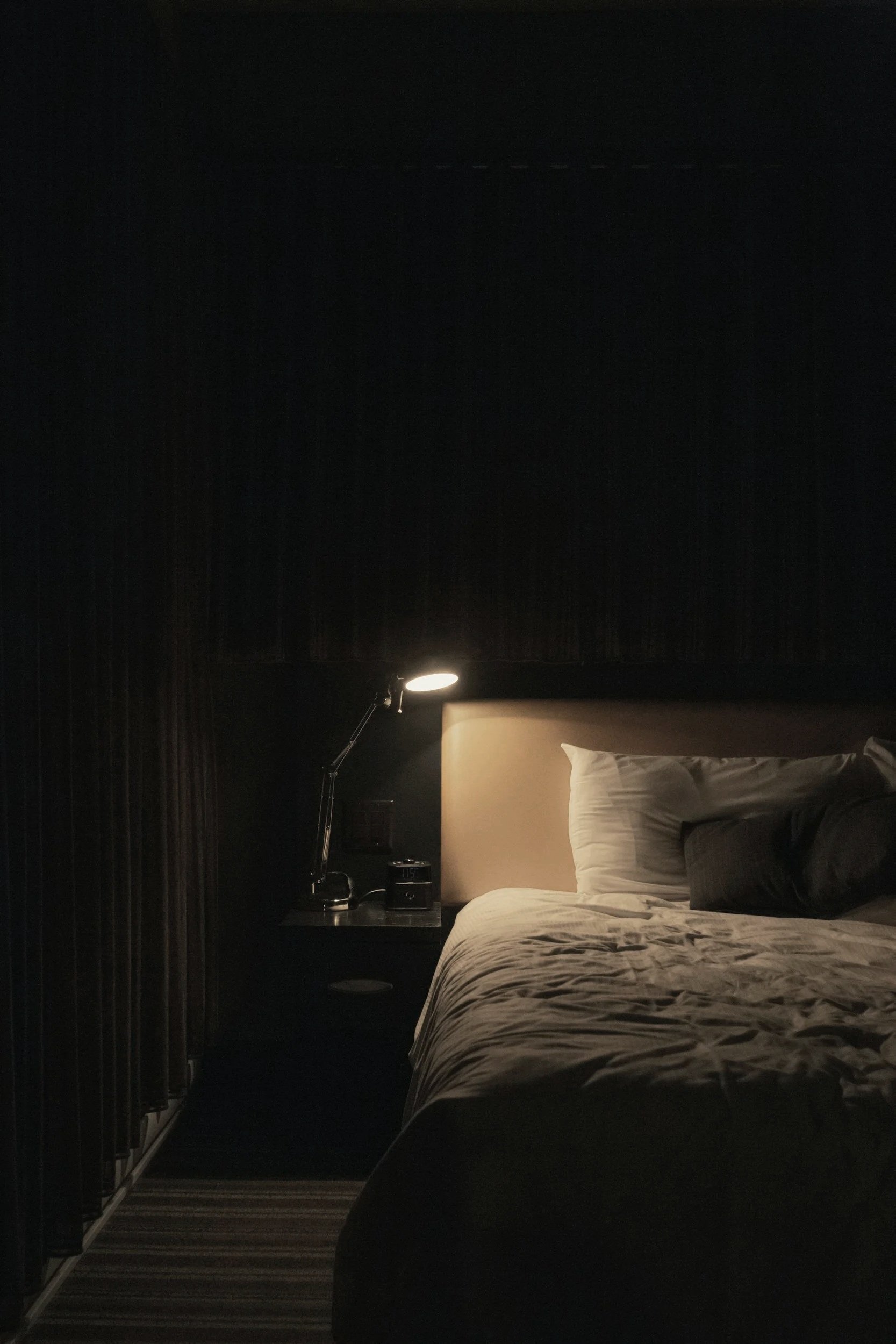
Anxiety is always looking for something to prepare for, prevent, or fix. That can be useful in small doses. It helps you remember deadlines, anticipate problems, and think ahead. But when anxiety becomes chronic, your brain can start treating every concern like an emergency that needs to be solved immediately.
At night, that might sound like mentally rehearsing tomorrow’s meeting, replaying a conversation, reviewing your finances, or imagining every possible outcome of a decision you haven’t even made yet. Your brain believes that if it thinks hard enough, it can prevent discomfort or uncertainty.
Unfortunately, most nighttime thoughts don’t lead to useful solutions. They lead to more questions, more tension, and less sleep.
Our article on Anxiety and Control explains why the brain often uses overthinking as a way to create a sense of control. If you can predict every possible problem, maybe nothing will catch you off guard. The issue is that your nervous system doesn’t know when to stop planning and start resting.
The More You Try to Force Sleep, the Harder It Gets
Few things are more frustrating than lying in bed while calculating how many hours of sleep you’ll get if you fall asleep right now.
Then ten minutes pass.
Now you’ll get six hours and forty minutes.
Then another twenty minutes pass, and suddenly you’re doing sleep math like your life depends on it.
Trying to force sleep often makes anxiety worse because it turns sleep into a performance. Instead of allowing your body to settle, you start monitoring whether it’s working. Every minute awake feels like evidence that something is wrong, which creates more pressure and more activation.
Your brain begins associating your bed with frustration, effort, and worry. You may feel exhausted on the couch, only to become wide awake the second your head hits the pillow. That shift isn’t imaginary. Your nervous system has started recognizing bedtime as the place where the struggle begins.
What Racing Thoughts at Night Can Sound Like
Not all nighttime anxiety looks like obvious panic. Sometimes it’s practical. Sometimes it’s self-critical. Sometimes it’s a long list of random thoughts that somehow all feel urgent at midnight.
You may find yourself reviewing things you need to do, worrying about your health, thinking about money, analyzing your relationship, or replaying mistakes from the past. You might also jump quickly from one topic to another, which makes it feel like your brain is running six browser tabs at once and none of them will close.
Some people experience racing thoughts as full sentences. Others notice images, memories, physical tension, or a vague sense that something bad is about to happen. Even when there isn’t one specific worry, the body may still feel restless and alert.
That’s an important point: Anxiety at night isn’t always just thinking. It’s often a full nervous system response.
Your Body May Be Tired While Your Nervous System Is Still Alert
Physical exhaustion and nervous system regulation are not the same thing.
You can be completely worn out and still feel unable to settle. This is especially common after high-stress days, emotionally intense work, conflict, or repeated exposure to unpredictable situations. Your muscles may feel heavy, but your body is still producing the internal signals associated with alertness.
For first responders, healthcare professionals, military personnel, and other people working in high-pressure environments, this pattern can become especially pronounced. The shift ends, but the nervous system doesn’t immediately get the message.
Our blog on first responder sleep problems explores how job-related stress, adrenaline, and cumulative trauma can interfere with sleep long after someone has left work. The same basic process can affect anyone whose nervous system has spent the day bracing, reacting, or staying two steps ahead.
Trauma Can Make Quiet Feel Unsafe
For people with trauma histories, nighttime can bring another layer of difficulty. Quiet and stillness may feel uncomfortable because the nervous system learned that staying alert was protective.
If your earlier environment was chaotic, unpredictable, or emotionally unsafe, relaxing may not feel natural. Your brain may continue scanning for problems even when nothing is actively wrong. In some cases, closing your eyes and becoming less aware of your surroundings can feel vulnerable.
This doesn’t always show up as a clear trauma memory. It may simply feel like restlessness, dread, hypervigilance, or an inability to fully let go. Our post on Trauma and Downtime looks more closely at why quiet moments can bring unresolved stress and emotional material to the surface.
When the nervous system equates stillness with vulnerability, sleep becomes much more complicated than turning off the lights and putting away your phone.
The Anxiety and Sleep Cycle
Anxiety disrupts sleep, but poor sleep also makes anxiety worse. (I know, it’s like a bad joke, right?) After a bad night of sleep, your brain has fewer resources for emotional regulation. Small problems feel bigger. Your patience gets shorter. Concentration becomes harder. You may rely on more caffeine to function, which can then make it harder to settle the following night.
As this cycle continues, people often become anxious about sleep itself. They start worrying during the day about whether they’ll sleep later. Bedtime arrives with a sense of dread instead of relief.
The original anxiety may have been about work, relationships, health, or stress. Over time, sleep becomes another source of anxiety layered on top of everything else.
Breaking that cycle usually requires more than one perfect nighttime routine. It requires addressing both the habits around sleep and the nervous system patterns keeping the body activated.
Why Generic Sleep Advice Sometimes Falls Short
Most people with insomnia or racing thoughts have already heard the usual advice: Avoid screens, keep the room dark, don’t drink caffeine late in the day, go to bed at the same time. We’ve heard it all.
Those recommendations aren’t useless. Consistent sleep habits can absolutely help. But they may not be enough when anxiety, trauma, or chronic stress is driving the problem. You can put your phone across the room, buy blackout curtains, and drink all the sleepy tea in South Carolina, but if your nervous system believes it needs to stay alert, it may continue doing exactly that.
Sleep hygiene addresses the environment around sleep. Therapy can help address why your body struggles to feel safe enough to rest.
What Can Help With Racing Thoughts at Night
The goal is not to completely eliminate every thought before sleep. That usually creates more pressure. A more realistic goal is helping your brain recognize that it doesn’t have to solve everything tonight.
Creating a transition period between activity and sleep can help. If you move directly from answering emails, watching intense television, or finishing chores into bed, your nervous system has very little time to shift gears. A lower-stimulation routine gives your body a clearer signal that the day is ending.
Some people also benefit from writing down the thoughts that keep circling. This isn’t about producing a beautiful journal entry. It can be as simple as listing what needs attention tomorrow so your brain doesn’t feel responsible for holding it all overnight.
It may also help to notice whether you’re trying to use bedtime as your only opportunity for emotional processing. If difficult thoughts consistently show up the moment you stop moving, creating small periods of reflection during the day can reduce the pressure that builds by nighttime. The most important shift is learning to respond to racing thoughts without treating them like emergencies. A thought can feel urgent without actually requiring action at 1:00 a.m.
How Therapy Helps Anxiety and Sleep

Therapy can help identify what your racing thoughts are trying to accomplish
Are they preparing you for uncertainty? Replaying unresolved conflict?
Protecting you from making a mistake?
Keeping difficult emotions at a distance?
Once the pattern becomes clearer, treatment can focus on more than simply distracting you until you fall asleep. For some people, traditional anxiety treatment helps reduce worry and challenge the belief that every thought needs to be solved. For others, the problem is more closely connected to trauma or chronic nervous system activation.
Approaches like EMDR Therapy and Brainspotting can help process experiences that continue keeping the brain and body on alert. The goal isn’t to erase every stressful memory. It’s to reduce the intensity of the response so your nervous system doesn’t keep reacting as if the threat is still present.
Trauma Therapy can also help you understand why rest feels difficult and build more tolerance for stillness without forcing your body into a level of relaxation it doesn’t yet trust.
Racing Thoughts and Sleep Problems in Charleston, SC
If you’re in Charleston, SC and anxiety is regularly interfering with sleep, it may be worth looking beyond your bedtime routine.
Racing thoughts at night are often connected to what your nervous system has been carrying throughout the day, or for much longer.
You may need practical changes around sleep. You may also need support with anxiety, trauma, emotional avoidance, or chronic stress. The goal isn’t to win a nightly argument with your brain. It’s to help your brain stop treating bedtime like the only safe time to review every problem you’ve ever had.
Takeaways
Racing thoughts often become louder at night because daytime distractions are gone and unresolved stress finally has room to surface.
Anxiety treats uncertainty like a problem that must be solved, which can turn bedtime into hours of planning, reviewing, and overthinking.
Trying to force sleep can create more pressure and teach the nervous system to associate bed with frustration.
Trauma, chronic stress, and high-pressure work can keep the body alert even when you’re physically exhausted.
Poor sleep and anxiety reinforce each other, creating a cycle that can become difficult to interrupt without support.
Sleep hygiene can help, but it may not fully address racing thoughts when anxiety or trauma is driving the problem.
Therapy, EMDR, and Brainspotting can help reduce nervous system activation and address the experiences or patterns keeping the mind on alert.
A Next Step
If your body is exhausted but your brain refuses to stop working at night, it may be worth exploring what your nervous system is trying to manage after the rest of the world gets quiet. If this feels familiar, feel free to reach out for a free consultation!